Gabriele Stellbaum.
*1962 in Berlin, GER, lives and works in Berlin, GER
studied at Art Academy, Hamburg und Dusseldorf, GER
Exhibitions [selection]:
2012
I bruise easily, Part I to III, Rupert Goldsworthy Gallery, New York, USA
2011 Honest Lies, C&H art space, Amsterdam
, NED
Art in the Parking Space, LAXart, Los Angeles, USA
2010 Soundgate, Kunsten Museum for Modern Art, Aalborg, DEN
2009
Bartleby, Rupert Goldsworthy Gallery, Berlin, GER
2007 The Blind, Florence Lynch Gallery, New York, USA
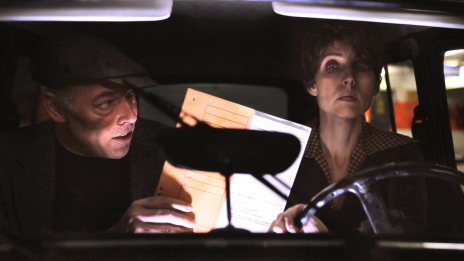
Honest Lies
Date: 2011
Length: 09:45 min.
Format: 16:9
Specifications: Colour, Sound, Single Channel
Courtesy C&H artspace, Amsterdam
Night-time. Under the electric strip lighting a woman wearing old-fashioned clothes drives an old-timer through a deserted car park, seemingly without a goal. On the back seat sits a young girl. Now and then the driver looks back at her with an expression of concern. The camera records signs which say “one way only” or “no entry”. Although the leading lady says nothing, we hear her hypnotic voice: She is letting us listen to her thoughts on morals, responsibility, and the feeling of helplessness of the opposition to an unspecified totalitarian system. The images repeatedly illustrate what she is thinking when long tracking-shots film the endless labyrinth of the car park and her voice speaks about an “architecture of lies”. The flow is interrupted by leaps in time and picture taken outside the car park in a wood or on a boat. An orange-coloured file, which is passed on during secret handovers accompanied by music from a spy film, has symbolic meaning. While the solitary car drives back and forwards on the parking deck, the voice speaks about the possibilities of undercover operations and blackmail. Arrows point in numerous directions, but for her there seems to be no way out of the situation. The viewer is held captive in the woman’s inner conflict and accompanies her on her never ending drive round the park house. But are her stories true or are they perhaps only metaphors for her thoughts?
Kim Mildebrath
Interview:
► 1. Your work has been chosen among over 2000 festival entries to participate in VIDEONALE.14. In which context do you prefer to present your work, festival/cinema context or exhibition? And what kind of difference does the respective mode of presentation mean for you / your work?
My work has been shown in exhibitions and also screened in cinemas. Both presentation formats are good for showing my videos and they also present advantages and drawbacks at the same time. My films are very atmospheric and work with a rather associative context. The large-screen cinema presentation allows the viewer to get completely absorbed in my videos while the world outside is shut off. Because artists' films usually get limited screenings in cinemas the possibility of presenting my work to a larger audience is somewhat rare. Screening my work in exhibitions is more accessible but requires a more complicated installation, lighting and sound set-up for the space and the installers. Nevertheless all the galleries I show with make it possible to present
my work in the best possible screening conditions. I personally prefer screening in an exhibition space because it does not limit the viewing of my work via a given timetable and it allows a more unique interaction with the work.
► 2. Art can be seen as a mirror that registers and reflects life or as a tool that transforms it. Is there a particular theme, concept or problem your art addresses the most?
The construction and conception of identity and political memory is a pivotal, reoccurring theme in much of my work, where the particular mise-en-scène locates the obtuse questions of identity within a complex of relationships: between societal structures, economy and the survival of the individual under political regimes which include repression and require civil courage. My characters are quietly rebellious in a repressive environment and are unable to fully succeed in their covertly antagonistic goals. For my film sets I search for architecture and designs that are emotionally charged and I use these sets to convey anonymity, failure and oppressiveness of socio-political systems. I choose colors and patterns with a particular muted palette to evoke a certain memory of bureaucracy and institutional spaces, but also to play with the notion of our own biases around visual encoding. My protagonists are often lost, marginalized or trapped in an impersonal urban environment.
► 3. In which way is the video medium an excellent possibility to express your intended subjects, especially in contrast to other media you use? Or do you work exclusively with video?
Video is a great medium to make my ideas and themes visible. I work exclusively with video but sometimes produce a few stills for exhibition purposes. Along with the fact that video is an audiencefriendly medium, I am very interested in telling stories and reaching out to the viewer. The high-def video format and new editing
programs offer great possibilities for independent artists, the production budget does not need to be huge now. My earlier video works were very performative and acting has always been an element in my productions. My scripts are sometimes partially improvised during shooting. Some of the camera takes are preplanned others by chance. The “by me” directed video camera provides total freedom and control in creating my work. I like to do
the unexpected and remain playful in my recording and editing processes.
► 4. If you have the chance to ask the visitors of the VIDEONALE.14 exhibition questions about your own work, what would be your question?
My work is quite associative and provides the viewer with clues rather than revealing the whole story. The audience has to make up their own mind what they think the protagonist is involved in, when and where the story is set and what will happen in the end. After watching “Honest Lies” what images, moods or words do you take home with you? What was your assumption of what the protagonist was up to and who or what were they about to betray?


