Tanja Deman.
*1982 in Split, CRO, lives and works in Split, CRO
studied at the Academy of Fine Arts in Zagreb, Cro und am Piet Zwart Institute, Rotterdam, NL
Exhibitions [Selection]:
2012 Deserted Utopia, Museo Revoltella, Trieste, ITA
Unseen, Westergasfabriek, Amsterdam, NL
2011 With One Eye on the Horizon, TENT, Rotterdam, NL
Plane/Surface: Public art project, Zagreb, CRO
2010 Photo off, Salon 2010, La Bellevilloise, Paris, FRA
Abode of vacancy
Date: 2011
Length: 06:55 min.
Format: 16:9
Specifications: Black and White, No Sound, Single Channel
Courtesy the artist
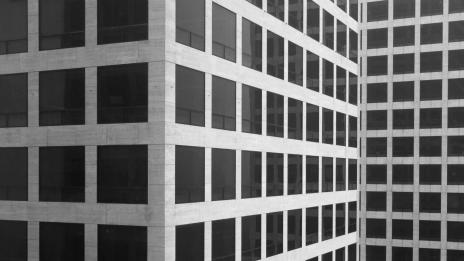
Landscapes. Images of architecture. Constructed pictures. Tanja Deman’s video presents a rhythmic succession of sequences showing landscapes and buildings, cut cleanly from one to another. The eye is led over a barren stone desert, then over a wide lake, wanders through abandoned buildings, goes from architecture to nature. The locations are always deserted. The pictures show the coasts of the Netherlands and southern Croatia, the cities of Rotterdam, Zagreb and Split. Every sequence is constructed symmetrically but avoids rigidity. Movement, in “Abode of Vacancy”, comes from the vertical or horizontal camerawork, but even more from the movements of nature: gentle waves on water, treetops swaying in the wind, mists drifting past, and also from a shadow in a hallway, visible only after a while. The images displayed are montages, amalgamations of landscape and architecture. Surreal, cinematic moments and spaces are the result, bringing the constructed and natural environments together as an “Abode of Vacancy”.
Anna Christine Kampe
Interview:
► 1. Your work has been chosen among over 2000 festival entries to participate in VIDEONALE.14. In which context do you prefer to present your work, festival/cinema context or exhibition? And what kind of difference does the respective mode of presentation mean for you / your work?
It is quite thrilling for me to see this work on a cinema screen, especially because it was not originally made for that context, but for the exhibition space in a form of an intimate video installation. So, showing it in the movie theatre in front of a wider film audience it inevitably becomes a group experience. This is an unexpected aspect. On the other hand when shown as a video installation, as a large projection in a dark silent space, in which only few people, sometimes only one person, comes in and bodily encounters it, it creates a very intimate atmosphere, as well as an experience.
► 2. Art can be seen as a mirror that registers and reflects life or as a tool that transforms it. Is there a particular theme, concept or problem your art addresses the most?
I’m mostly interested in collective psychology in relation to the architectural legacy and environment. Usually sites and spatial situations layered with history and subtle, but conflicting atmospheres trigger me. Through these spaces I can observe the dynamics of the socio-political environment we live in.
► 3. In which way is the video medium an excellent possibility to express your intended subjects, especially in contrast to other media you use? Or do you work exclusively with video?
I work in the medium of photography, photo-collages, video and light installation, which actually results into one main medium, medium of light. But through video, which has a component of time passing I can create a sense of contemplation in movement. In the video “Abode of Vacancy” I synthesised my experiences working with photo-collages and light installations. The video is composed of a series of collaged tableau with subtle movements and I constructed the frames through a relationship between cinematic image and stills, within the notion of time. And secondly it is more about experiencing the space than about watching, similarly as in the medium of installations.
► 4. If you have the chance to ask the visitors of the VIDEONALE.14 exhibition questions about your own work, what would be your question?
What does it enhance or what kind of experience does it create?


