Evamaria Schaller.
* 1980 in Graz, AUT, lives and worls in Cologne, GER
2007-2011 Kunsthochschule für Medien, Cologne, GER
2004-2005 FAMU, Prag, CZ
2002-2006 Universität der angewandten Wissenschaften, Salzburg, AUT
2001-2002 Academy of Photography, Graz, AUT
Exhibitions [Selection]:
2012 International Multimedia Art Festival, Yangon, Myanmar
25th Festival Les Instants Vidéo, Marseille, FRA
Spread Videoart Project, Tokyo, JAP
2011 Künstlerforum Bonn, PAErsche-Performance
Ars Cameralis, MühlenkampfIntervention,Katowice, PL
A Festival for Video and digital Culture - Machine Raum, Vejle Art Museum, DK
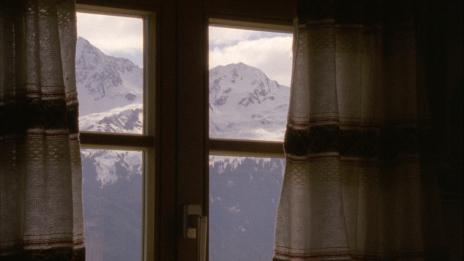
Die Wilderin von Montafon
Date: 2011
Length: 21:20 min.
Format: 16:9
Specifications: Colour, Sound, Single Channel
Courtesy the artist and KHM Köln
The eye tracks across a mountain panorama, from afar it fixes on the details of a cabin, bird song can be heard. The first scene in Eva Maria Schaller’s “Die Wilderin von Montafon” (The poacher of Montafon) shows a picturesque idyll. Pictures of mountains, wild rivers and green forests run through the whole film. Nature is the defining motif and in places the film is reminiscent of a “Heimatfilm” (homeland film). These idylls are interrupted by surreal scenes in which a young woman binds herself to a tree using cling film, or runs through the wood wearing antlers, just like a hunted deer. The protagonist does not merely live in the middle of nature, she literally merges with it. Documentary-like scenes, in which an older huntress appears, are edited into this surreal tale. The hunting scenes of the younger and the older woman are woven into a puzzling storyline whose incongruent visual language is reinforced by the use of various film formats. Close-ups of water, hide, meat and wood give the film a strong haptic effect. The artist, who is also the actress, examines the historical figure of the Wilderin von Montafon, who was active in the Austrian mountains in the 1980s. Since it was not possible to depict the poacher herself, the artist interpreted the events after her own fashion.
Stefanie Maria Weisshorn
Interview:
► 1. Your work has been chosen among over 2000 festival entries to participate in VIDEONALE.14. In which context do you prefer to present your work, festival/cinema context or exhibition? And what kind of difference does the respective mode of presentation mean for you / your work?
I would love to present my film in the context of the exhibition. It was not planned as a "cinema"-movie.
I also presented the work for my diploma in an exhibition combined with an audio-installation and objects.
In the exhibition there is the possibility to come back to stay concentrated. Even when you just see only some moments of the film it hits you different. For sure it is really good to present a film in cinema as well, there you have a big audience, people are in this black box and are concentrated to see the movie, because there is nothing else to see, except your sitting neighbors. But this movie comes also out of life. And there is not only one reality in life. There are a lot of different parallel-worlds and parallel-truths. It is the simultaneous view I am interested in. Everything is influencing - also how you watch a movie.
► 2. Art can be seen as a mirror that registers and reflects life or as a tool that transforms it. Is there a particular theme, concept or problem your art addresses the most?
The topic of the film was connected to this kind of reflections, yes. The topic of poaching, especially when a woman does it, quite hit me, when I first heard about it. And it was a real story! I was looking for this special woman for about half a year until I got her telephone-number. It had also the feeling of poaching, of hunting something - not something - a human being with a special story. But not in an journalistic way. I wanted to get to know more about her and the moment we´ve met, it felt as if we have been knowing us for a long time.
There were a lot of connections between us - my own childhood or the longing for deep loneliness what you only can find in nature. The topic of nationality, home and being in between, the liminality is a topic I am working on a lot. This feeling of being "in steady transformation",walking along an edge, where everything could change from one moment to another, those transformational moments are ideas which all of my artworks address. Also the social environment influences. I interact with site-specific conditions where I have to adjust myself. It doesn´t matter if in filmmaking or performance Art, it has to do with respect for each other and communication with people and space.
► 3. In which way is the video medium an excellent possibility to express your intended subjects, especially in contrast to other media you use? Or do you work exclusively with video?
I work as a performance-artist and film-artist. I use both kinds of expressions and combine them. There is no artistic expression more important than the other, but can support each other quite well. Also in my film "Die Wilderin vom Montafon" I use performances as "storyline", as an reflection of what happens in those mountains. Film - especially the Super8mm film, carries a lot of history and historical aesthetics which I love. It is the performativity of the film-material I am interested in. First it is hidden in a little black box after exposing it. It needs time and chemicals to process and afterwards it is an haptical material, which can be cut manually. The idea of this process is both in performance Art and film-art quite important. The process of creation and showing. For sure the film has different qualities than the performance Art. It is repeatable. But even the situation you are watching a movie can not recur.
► 4. If you have the chance to ask the visitors of the VIDEONALE.14 exhibition questions about your own work, what would be your question?
What situations stay in your memory after watching the movie and how do you connect it to your own life?


