Daniel Kötter.
* 1975, lives and works in Berlin, GER
studied at Humboldt Universität Berlin, GER
Exhibitions [Selection]:
2012 State-theatre #1-3, Raf Art Gallery, IRA
Arbeit und Freizeit (2) - Fiesta y ensayo, AutokonßtrukSchön, arratia.beer Galerie, Berlin, GER
2011 Vernissage, CSW Ujazdowski Castle, Warschau, PoL
Treppe, Atelier Frankfurt, GER
Re-Import The National Theatre of Bulgaria, Credo Bonum Gallery Sofia, BUL
2010 Film für übers Sofa, Kunstfilmbiennale, KW-Institute for contemporary art, Berlin, GER
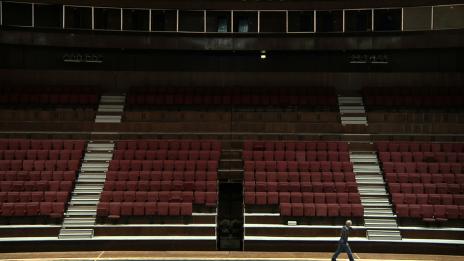
Bühne (Rahmen-Analyse Varna, 28. November 2011)
Date: 2012
Length: 17:00 min.
Format: 16:9
Specifications: Colour, Sound, Single Channel
Courtesy the artist
The beginning of Daniel Kötter’s „Bühne“ (Stage) looks just like the usual preparation for a theatre performance: In an empty auditorium voices can be heard, a sound check is carried out and the lighting is also checked. The camera is focuses on a frontal view of the auditorium when an indefinable monotonous sound is suddenly heard. The view, however, does not change. Only after a few moments do changes in the picture become obvious and the regular arrangement of the picture is lost: the seats start to change almost imperceptably and the rows start to lose their geometrical arrangement. In a slow metamorphosis, the rows of seats fold away and the room changes bit by bit from an auditorium to a stage. The monotonous sound ceases, voices can again be heard in the background and the transformation has been carried out. The pictures depict the transformation of an auditorium in the Palace of Sport and Culture in post-communist Varna. Formerly objects of prestige and representation in the socialist state, the monumental buildings, in their changed use, stand for the social and political shifts after the change of regime.
Nelly Bews
Interview:
► 1. Your work has been chosen among over 2000 festival entries to participate in VIDEONALE.14. In which context do you prefer to present your work, festival/cinema context or exhibition? And what kind of difference does the respective mode of presentation mean for you / your work?
The fundamental difference between cinema or exhibition presentation is no longer the spatial quality of the screening but still the different concepts of temporality. A cinema screening has its own temporality while a looped presentation in an exhibition allows the viewer/visitor to reconstruct and conceive his/her own timing. Some of my work deals with these different modes of time. That is why, although I mostly have a preferred way of presenting a specific film, I am always curious, to what extent a different way of presenting will change the perception of time in a time-based media work. So I am fine with both modes as long as the consequences for the perception are reflected on.
► 2. Art can be seen as a mirror that registers and reflects life or as a tool that transforms it. Is there a particular theme, concept or problem your art addresses the most?
I doubt the concept of art being a "mirror" of life. Each art work by default is part of the set of facts we call life, I guess. My works, documentary, performative or experimental, mostly start with the conditions (through researching and analysing) and the construction (through camera work, choice of frame etc) of space, transferred into a temporal phenomenon, I reckon. By this I mean it starts with the analysis of places, locations, environments that potentially could or actually did in the past provide and shape opportunities for social encounters. A specific interest seems to be the allegoric space of encounter, call it "theatre".
► 3. In which way is the video medium an excellent possibility to express your intended subjects, especially in contrast to other media you use? Or do you work exclusively with video?
The places, locations and environments I mentioned above have their own temporality. They change their function in time, through behavior, work, social, economic and political movement. Video, being time-based, is a convenient medium (though not the only one) to make this temporailty of a social space/location/environment part of the viewers experience. And video, unlike theatre, but similar to internet, can transfer spaces into other spaces, make places accessible to viewers that are far from them. I think this might suit my interest in documentary techniques aswell as structuralist filmmaking.
► 4. If you have the chance to ask the visitors of the VIDEONALE.14 exhibition questions about your own work, what would be your question?
hm, well two options:
a) At what moment of the film "Bühne" did you understand what was going on?
b) Did you like it?


